


Glass Taper Joints
Conical taper joints are a very common way to connect lab glass components. They are called male and female joints, for obvious reasons we hope, and permit quick, leak-tight fittings. They are manufactured by forming tubing into a conical taper, very near the final dimension, then grinding the conical surface to a standard size. They are nearly universally a 1:10 taper.
Generally, the designation for taper joint sizes are two numbers, separated by a slash. Referencing the male version in the image on the right, the first number is the diameter, in millimeters, of the ground part of the joint at the top (largest diameter), and the second number is the length of the ground section; this 24/40 joint is 24 mm at the top (widest diameter), and 40 mm long. This means that if the first numbers of a male and female set are not the same, those joints will not fit together; if they are, they will - a 24/25 male joint will fit into a 24/40 female joint, although the lengths will be different.
There are "full length" joints, "medium length" joints, European ISO standard joints, stopper joints, and a variety of odd sizes. Stopper joints are an exception in that they are designated by only one number, the major diameter. They are used primarily on volumetric ware and separatory funnels.
In use, it is a good idea to lubricate taper joints with an appropriate grease. Teflon sleeves can be interposed to avoid wedging the male and female together, as they can become stuck or "frozen". Be very careful not to use too much force in trying to separate frozen joints; if the glass breaks it will do so suddenly, with nasty sharp edges that will cut your hand.
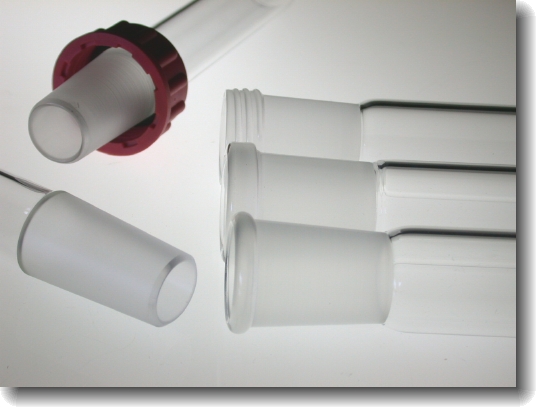
24/40 standard tapered joints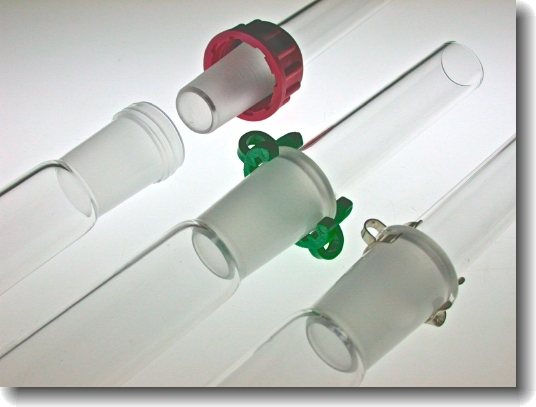
The image above shows:
-the Rodoviss format w Red threaded retaining Cap
-24/40 joints w Keck clips; green plastic and stainless