


Laboratory Glass Repairs
Think of it as high-tech recycling. Most glassblowing shops perform repairs as part of doing business. We can and do repair all sorts of laboratory glassware. Any items more complex than beakers and testtubes are fair game, but this work does come with a risk.
Individually, each piece of broken lab glass is a unique situation although the fix is often straight forward: reattach or replace a joint, thread, or stopcock, seal a star crack, fill chips in a flange, etc. Emailing a photo can be very informative in terms of a rough estimate. We won't charge more than half the value of the new item without consulting you. If the glassware is broken in a "working" area, that is, the shell of a stopcock, the ground part of a joint, a flange, etc., those parts can be replaced as good as new. We strive for good as new - repairs are carried out in the same manner as manufacture of new lab glassware
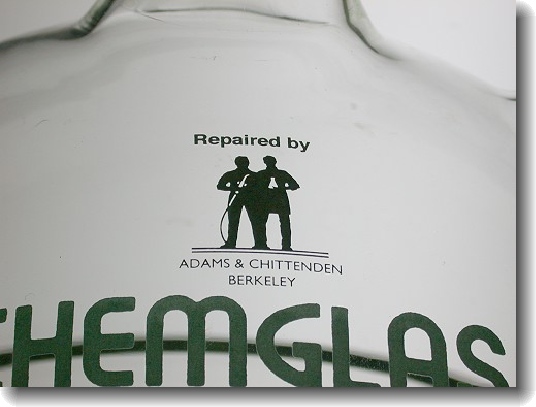
We understand that a broken piece of glassware can cause serious setbacks for the user and we will try to accommodate your needs for rapid service when necessary. We maintain a stock of most sizes of tubing and components, so we often have the necessary materials in hand. We do charge to expedite orders, and we will be clear when we are not able do so.
We require that lab glassware needing repair be clean, and we must know what any contamination might be. In the course of repair, the glassblower frequently needs to connect a blowtube to the glass to blow and/or suck to work a seal. A specific problem is silicone adhesives, greases, and heating oils, commonly used on manifold stopcocks and cooling coils in condensers; citrus-based solvents work well for this cleaning. Silcone adhesives are especially pernicious; burning silicone products produces toxic fumes and will create health hazards for the glassblowers and damage our ovens, not to mention your glassware! At our discretion, we will return dirty glassware unrepaired. Any time we must spend cleaning will be charged at double our normal shop rate; we are expensive dish washers. A rule of thumb - if you would be willing to drink water from it, it may be clean enough.
If you ship us glassware for repair, please pack it carefully. This generally means plenty of packing between items; we like bubblepack around the glass, and starch based foam pellets (Eco-Foam or Renature) to fill. Leave plenty of room between the items and the walls of the box. Best is to overfill the box with pellets, then snug them down when you tape the box closed; this locks the glassware in place within the box. Remember, the shippers are specifically allowed to drop any box four feet, and don't think they won't. We also like it if you can put tape over the nasty sharp edges, so we don't shred our fingers unwrapping.